|
Service Record |
From |
To |
|
Corner Brook SOS |
WW2 |
|
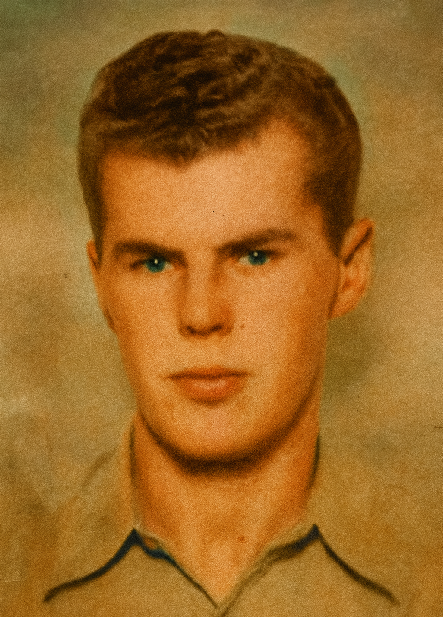
Thomas Augustus Cossit
“Gus”
Service in WW2
The first ship I sailed on was a Greek vessel. I joined her on a pierhead jump—last minute—and stayed for just a few months before getting off. Eventually, I made my way to the UK, where I joined one of the Bowater Steamship Company’s ships, the SS Corner Brook, which was named after the town here in Newfoundland. I sailed on her twice: the first stint lasted 11 months, and the second about eight. In between, I served on other ships as well, making several convoy crossings to the UK and West Africa.
The Corner Brook was originally built in 1925 in Newcastle-upon-Tyne as a paper carrier. Two ships were built at that time for the Bowater paper company here in Corner Brook: the SS Humber Arm and the Corner Brook. The Corner Brook was known as the “lucky ship.” She made 70 crossings of the western ocean to the UK and beyond. Her captain at the time was C.K. Homer, and she was chosen as the Commodore Ship—meaning she led the convoy—a total of 12 times. She carried the commodore, the senior captain in the convoy. The reason she was chosen so often was simple: she was fast, she was clean, and she was a good feeder. She also had excellent accommodations—at least for the officers. Things were a bit different for the crew, of course, but that’s how it was.
She made 68 or 70 crossings—I forget the exact number now—and of course, that counts both going over and coming back. She was a damn good ship, flying under the funnel colours of Furness Withy, the agents for Bowater at the time.
When I joined, I started as a Junior Ordinary Seaman (JOS). From there, I moved up to Senior Ordinary Seaman (SOS). At the time, there was a shortage of Able Seamen (ABs), so they introduced a new rating: Efficient Deck Hand (EDH). You had to pass an exam for it, and if you knew your seamanship well enough, you got the rating. It paid the same as an AB, just a pound less—British wages, that is. After four years "before the mast," meaning active sea time, you became a full-fledged Able Seaman. That was four full years of sea time—shore leave didn’t count. If you were on a ship for six months, then off for a month, that month didn’t count. It had to be four years at sea.
One of the harshest things was that if your ship was torpedoed, mined, or wrecked—once that ship was lost, your pay stopped immediately. Even if you were in a lifeboat for five minutes, five days, or five weeks, you weren’t paid a cent for that time. It was completely unfair. Some companies, later on, would reimburse you for lost clothing and gear, but back then, most seamen didn’t own much anyway. A suit cost maybe $18 or $19, so there wasn’t much to lose—but still, it was all we had.
The worst part of it all, though, was sailing in the North Atlantic during the winter. It was the coldest, most miserable place in the world. Ice built up on everything—you had to cut and chop it constantly. We always seemed to be cold, always seemed to be wet. And on British ships, the food was different than what we Newfoundlanders were used to. We had fresh food for maybe two days, and after that, it was curry and rice, and mutton—so much mutton. To this day, I can’t even wear wool socks because it reminds me of it.
But despite all that, I loved every minute of it. I sailed with good shipmates, on good ships, for good companies—some better than others, sure—but I was lucky. I had a say in the ships I ended up on, and because I really wanted to be there, I always managed to get by.