Date of attack
16 Aug 1940
Fate
Sunk by U-30 (Fritz-Julius Lemp)
Position 57.30N, 17.14W - Grid AL 3783

Complement
108 (67 dead and 41 survivors).
Convoy
OB-197
Route
Glasgow - Liverpool - Bombay - coast of Malabar
Cargo
6700 tons of general cargo
Notes on loss
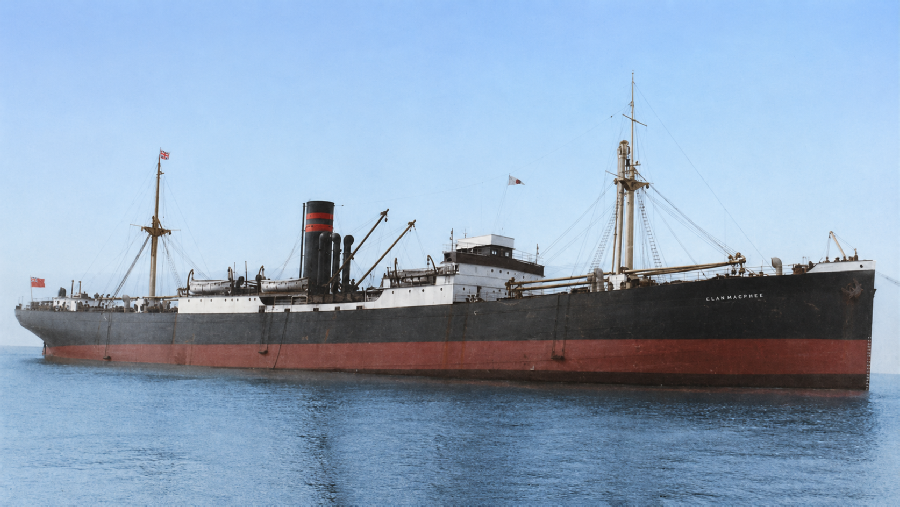
At 19.32 hours on 16 Aug, 1940, the Clan Macphee (Master Thomas Philip B. Cranwell) in convoy OB-197 was hit by one torpedo from U-30 and sank about 350 miles west of North Uist, Outer Hebrides.
The master and 66 crew members were lost. 41 survivors were picked up by the Kelet, which was sunk by UA (Cohausz) on 19 Aug, 1940.
Six survivors from the Clan Macphee were lost, the remaining 35 survivors were picked up by the Norwegian steam merchant Varegg and landed at Galway on 26 August.
|
Master
|
Date
|
Left
|
Destination
|
|
E C Ody
|
1911 - 1918
|
|
|
|
|
6/1915
|
Glasgow
|
Cape Town
|
|
L G Openshaw
|
1918 -
|
|
|
|
A R Cossar
|
1935
|
|
|
Crew List
1914 Requisitioned as Indian Expeditionary Force transport
1916 Requisitioned as East African transport
1940 Torpedoed and sunk in Atlantic
|
Vessel
|
Built
|
Tonnage
|
Official No
|
Ship Builder
|
Engine Builder
|
Engine Type
|
HP
|
Screws
|
Speed
|
|
Clan MacPhee
|
1911
|
5177
|
129578
|
Irvine’s Ship Building
West Hartlepool
|
Richardson Westgarth
Hartlepool
|
Triple Expansion Steam
|
657 NHP
3600 IHP
|
1
|
12
|

|
Master
|
Date
|
Left
|
Destination
|
|
H Simpson
|
11/1937
|
|
|
|
T P Cranwill
|
8/1940
|
Glasgow
|
Bombay
|
Career Summary
Torpedoed and Sunk - 1940
Rescue of Crew and Passengers of Sailing Ship Diego - 1935
In 1935, Captain Cossar was Master of the Clan Macphee, sailing from Britain to India. The voyage was unexceptional, until the MacPhee, entering Indian waters received a message via telegram from Cayzer House. The Mauritian owner of an elderly iron barque had heard nothing from his ship, the SS Diego, for some months after a heavy storm in June, somewhere in the vicinity of the Chagos Islands. He had contacted Cayzer House to ask if the MacPhee, roughly in the area, could have a look around the islands and see if they could locate any survivors from his ship (he did not seem worried about the barque). The ship owner offered the advice not to make a search at night, as there were many coral reefs around the Chagos Islands. The message was passed from Cayzer House to Captain Cossar, and he paused his own voyage for a short while to investigate the Chagos Islands as instructed. The islands were generally rather bare and unappealing. Very few people actually lived on these fairly barren islands, and ships did not sail by these islands very often if at all, since there were no regular shipping routes in this area. The small, scattered population did not offer much in the way of commerce.
Captain Cossar started looking around the islands, only in daylight as advised, and always on the lookout for the coral reefs. After looking over a couple of deserted islands, it didn’t seem very likely that anyone had made it ashore from the missing ship. Then one sharp-eyed officer said that he was fairly certain he could see something moving on another of the islands. The Captain took a look at this island, as yet unexamined, and agreed to investigate. The ship dropped anchor quite a distance from the island, to avoid the reefs; and the Captain with a few officers took one of the lifeboats to row nearer to the island. As the boat started making its careful way towards this new island, the beach front suddenly lit up with lines of small fires since this particular island, known as Eagle Island was in fact quite unequivocally occupied. Arriving near enough the beach to get safely out of the lifeboat, Captain Cossar and his officers were very surprised to be met by quite a large number of people – the passengers, crew, and captain of the missing barque. There were sixty-eight men, women, and children, every one of whom had been rescued from the wrecked SS Diego. The oldest was an elderly woman who was about to turn 100; and the youngest was a six-month old baby. These castaways had been living on Eagle Island for 10 weeks, with a diet limited to coconuts, bird’s eggs and rice, in various imaginative combinations.
So how had the 68 passengers and crew survived the storm which destroyed their barque? As it had become obvious that the barque was doomed during the storm back in June, the Master of the ship, Mr F.H.Adam, had got everyone aboard into a small boat which seems to have been the Diego’s only lifeboat, and with his crew had started to row towards the nearest island, which happened to be Eagle Island. This particular island was visited by a handful of locals periodically to pick coconuts, and when they saw the small boat being rowed towards the island, one of these men got into his dug-out, rowed out to meet the boat, and towed it over to Eagle Island. After that they were on their own, and Captain Adam did an extraordinary job in keeping everyone too busy to worry about their situation. The Captain divided everyone into groups. Women were in charge of cooking and weaving baskets from coconut palm fronds to organise their salvaged possessions. Men were tasked with building shelters, and foraging for anything edible. The Captain also ordered a 24- hour watch to be kept on the sea, in case a ship came by. The crew and officers would have been the best people to do this. Children were distracted by giving them lessons or helping their families. Overall, everyone knew exactly what they needed to do for the common good and no-one rebelled. The men had also built a ”flagstaff”, although the photos of it seem to be more of a tall wooden frame, on which they could hang a flag, or any piece of clothing, hence the movement that the Macphee’s officer had noticed. They had also made small piles of tinder, ready to be lit if any ship came into view in the hope of attracting attention. It spoke volumes that not one ship had passed by Eagle Island until the man in Mauritius made his request to Cayzer House. Eagle Island was not a particularly hospitable island, unless you were a rat or a mosquito. The water tasted brackish, and the only edible items on the island were coconuts and birds’ eggs. Someone had brought a large bag of rice along in the escape from the Diego, and when rice ran out, the men patched up the boat from the Diego which had been dragged over the coral reef, and was now a little leaky. Once patched, one of the Diego’s officers rowed the boat over to the next island, Peros Banhos, which was a slightly larger island with a slightly larger populace and more importantly it had a shop where one might buy a bag of rice. Over the months, the officer would end up making more than one visit to Peros Banhos for rice. Captain Cossar arrived just at the right time, as the castaways were down to their last bag of rice.
As soon as possible the two captains agreed the plan of action. Once again, the locals helped out, and between them they got everyone off Eagle Island, this time using the Macphee lifeboat, which had to be rowed out to where the SS Macphee was still anchored.
The only real challenge was having to climb up the side of the Macphee on a rather rickety rope ladder. Once everyone was aboard, Captain Cossar steered the ship over to Peros Banhos where he unloaded the 68 castaways. Peros Banhos was a rare island with a population of a few hundred people, and was also the island that was the nearest to the Maldives.